|



| HOME: COUNTRY OVERVIEW INDEX: Costa Rica Climate |  |
|
| Recommend
this site to a friend! |
||
 |
Often considered as the "land of eternal spring" by its inhabitants, Costa Rica's mild climate is the envy of many a visitor from the North. Being a tropical country it has distinct wet and dry seasons. However, some regions are rainy all year, while others are very dry and sunny most of the year. While definitely a misnomer, summer or more precisely Costa Rica's dry season, runs from Mid-November to April; the rainy or "green" season, from May to Mid-November. Given the topography of the country, Costa Rica can boast a wide range of microclimates and these in turn give way to the great diversity of flora and fauna. In Guanacaste, the dry northwestern province, the dry season lasts several weeks longer than in other places. Even in the rainy season, days often start sunny, with rain falling in the afternoon and evening. On the Caribbean coast, especially south of Limón, you can count on rain year-round, although this area gets less rain in September and October than the rest of the country. Generally speaking, the best time of year to visit weather-wise is in December and January, when everything is still green from the rains, but the skies are clear. |
|

Temperature Temperatures don’t change much throughout the year since they vary primarily with elevations, not with seasons. Below 800 meters above sea level the temperature normally ranges between 25 and 32°C (77 - 89 F). Regions like the Central Valley from 800 to 2,500 meters, the temperatures range from 14 to 25°C (58 - 77 F), and above 2,500 the temperatures are normally below 14°C (58 F) Frost is common at the highest elevations (3,000 - 3,600m / 9,840 - 11,808 ft). Normally, the difference in the mean temperature from the warmest to the coolest months is no more than five degrees Cº (Celsius).
As mentioned before, the main change in seasons is the amount of rainfall. The rainy season extends from May to the middle of November in the northern regions, and from April to December in the south. The dry season takes in the rest of the year, and is defined by two phases; December, January, February with cool temperatures, cloudy skies and chilly winds, and March and April when the sky remains clear for most of the day, with light breezes, and when the highest temperatures of the year are reached. The light breezes and absence of rain favors the formation of fog due to the accumulation of dust and pollutants in the air. During the dry season, the differences between the high day temperatures and low night temperatures are more pronounced. The rainiest month in the north and in the Central Tectonic Depression is September, while in the south it tends to be October. Rains usually occur in the afternoon or evening, so if you plan to travel to Costa Rica keep this in mind and enjoy the sun during the morning and early afternoon hours. During July and August there are short dry spells called "veranillos" ("little summers"). On the Caribbean coast and northern regions, there is no definitive dry season. In the coastal zones there are, however, relatively dry periods in March and April and another in September and October. In these zones the rains usually occurs late in the afternoon and/or at night.
|
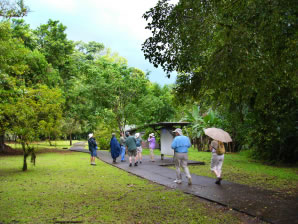 Costa Rica has two main rainfall regions, one on the Caribbean side and the other on the Pacific side; this includes the northern, central, and southern regions, as well as the Central Plateau.
 The trade winds blowing from east to northeast prevail in Costa Rica throughout the year. Usually, their velocity is below 15 km/hour, but in January and February they may reach 30 km/hour. On the Pacific side breezes come out of the west, from April to October, favoring the formation of rain clouds. These breezes are light for the most part averaging around 10 km/hour.
|
 Back to Costa Rica Overview Index


